Generative AI has made it possible to generate stunning images or transform existing photos into something entirely new, all from a text prompt.
But everything changes when you take a photo. In this case, you’re no longer asking AI to imagine a better subject. You’re asking it to produce a better photo of the subject already in front of the camera. The prompt is no longer text. It’s the simple act of pointing the camera.
In other words, photography changes the role of AI completely. Instead of imagining what the subject should look like from a user instruction, it must understand on its own what can be changed, how it should be changed, and what must never change. The photo can improve. The subject cannot. All without any extra effort from the photographer.
Trust starts with photography 🔗
Whether you’re buying a product, booking a holiday rental, choosing a restaurant, shopping for a used car or deciding to meet someone, you’re making a decision based on photos. Every photo carries an implicit promise: “What you see is what you’ll find in reality.” That promise is the foundation of trust.
If AI changes the subject - even subtly - that trust begins to erode. A product with a different finish. A room that looks larger than it is. A meal that looks fresher. A car with fewer scratches. A face with smoother skin. The image may look more attractive, but it no longer represents reality faithfully.
Trust requires subject fidelity 🔗
Improving a photo should never require changing the subject. We call this subject fidelity. It has two equally important dimensions.
Appearance fidelity 🔗
The subject should preserve everything that defines its identity. That includes:
- the grain of leather,
- the finish of a wooden floor,
- the sear on a steak,
- the logo on a car,
- the freckles on a face.
AI shouldn’t invent cleaner details or reinterpret existing ones. The subject itself is the ground truth.
Spatial fidelity 🔗
The subject should also preserve its geometry. It shouldn’t be:
- reposed,
- reshaped,
- reinterpreted,
- regenerated.
Its silhouette, proportions and spatial arrangement should remain faithful to the original scene. A successful AI photo isn’t one that depicts a similar subject. It’s one that still depicts the exact same subject, only photographed better.
Once trust is preserved, AI can improve the photograph 🔗
Subject fidelity isn’t the objective. It’s the constraint. Once the subject is faithfully preserved, AI can focus on what it does best. It can:
- remove distracting backgrounds,
- balance lighting,
- eliminate presentation aids,
- normalize framing,
- produce clean, consistent photography.
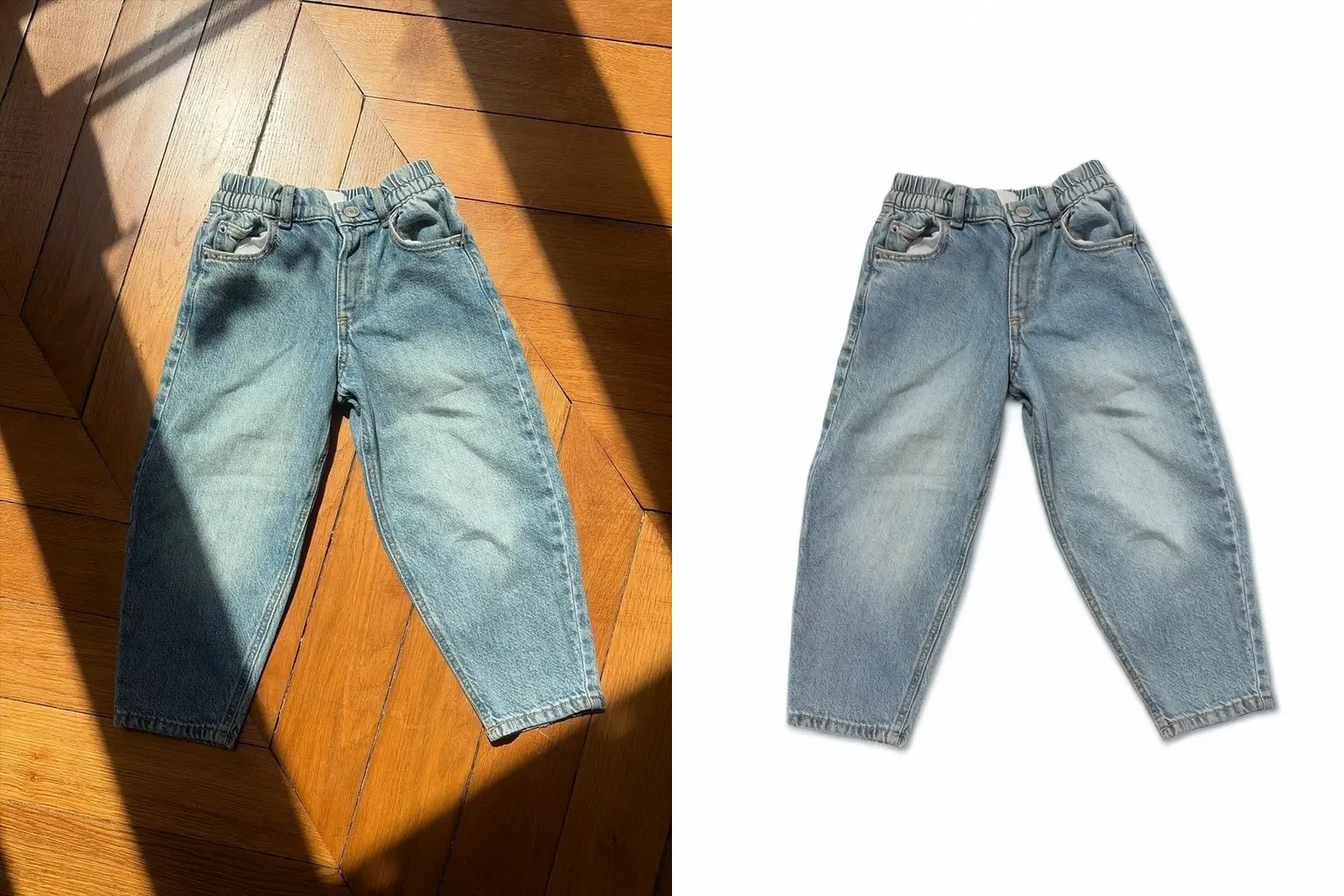
Notice what’s changing. Not the subject. The photograph. That’s the fundamental difference between AI photography and AI image generation.
The camera becomes the interface 🔗
Most generative AI systems ask users to describe what they want:
“Place this sweater on a white background with soft studio lighting.”
Photography already has a better interface. The camera. By pressing the shutter, the user has already expressed their intent. They’re saying:
“Help me produce the best possible photo of this subject.”
The camera already knows:
- what the subject is,
- where it is,
- how it is presented,
- which transformations make sense for this scene.
In other words, the act of taking the picture is the prompt. Everything else should happen automatically, in near real time.
A different future for AI photography 🔗
For nearly two centuries, photography has been about pointing a camera at reality and pressing the shutter. We don’t think AI should change that interaction. It should simply make every photograph better while remaining faithful to the subject in front of the camera. Because in photography, reality already exists. The subject is the ground truth. And trust begins by preserving it.